
Medically reviewed by Nokta İşitme Audiology Team (Audiologist) according to hearing health information standards.
Someone coming for a hearing test for the first time usually asks: "Does it hurt?" It doesn't hurt. You sit down, put on headphones, and raise your hand when you hear a sound. That's all. However, it is normal to research "how to do a hearing test" - everything that is unknown makes people nervous.
A lady who came to Bozyaka last month made an appointment at her daughter's insistence. "You turn on the TV too much, get tested," said the daughter. As the woman entered the door, she still seemed to be wondering, "Did I come here for nothing?" When the test was over, he said, "I've been missing high-pitched sounds for years, so that's why I couldn't understand the cashier at the grocery store." Hearing testing is not something to be afraid of; Something that ends uncertainty.
What is a Hearing Test?
A hearing test is an evaluation that measures how well your ears respond to different tones of sound. The only question is not «do you hear well»; It depends on what frequency you hear and how weak it is. This profile is shown with a graph called audiogram.
The test does not just produce numbers. Your complaints are listened to, the ears are checked, measurements are made, and the results are discussed. Our Hearing test service covers this whole — not just putting on headphones and leaving.
Which symptoms are required?
Not everyone needs a yearly test; But if there are symptoms, do not wait. Evaluation makes sense if you experience the following:
- Having to repeat conversations frequently
- Not being able to distinguish in a crowd
- Constantly increasing the television or phone volume
- Meaning "my ears are ringing" (tinnitus)
- Weaker sensation in one ear than the other
- Your relatives saying "Can't you hear?"
Annual check-up is a good habit over the age of 55. Those who work in noisy jobs should be screened earlier. If you have no symptoms but are curious, you can come — it's not a crime.
Pre-Test Preparation
Good news: no special preparation. You don't have to come hungry, stop taking medication, or go on a diet days in advance. Just come in comfortable clothes.
Situations when you should postpone
If you have an ear infection, acute pain, or discharge from the ear, go to the ENT first. In severe colds, middle ear pressure changes; The test may be misleading. Waiting 24–48 hours after a concert or a very noisy environment makes the measurement more accurate.
You'd better bring it with you
Old test results, list of medications you use, your current hearing aid if you have one. A loved one can accompany you — especially listening to the results together makes next steps easier.
What Happens During the Test?
The process consists of four main steps. There is no rush.
1. Preliminary meeting
Your complaints are listened to in the first 10-15 minutes. How long have you been struggling, and in what environments — restaurant, business meeting, at home? Noisy work, ear trauma, hearing loss, tinnitus in the family? This information is important when interpreting the result.
2. Ear check
The ear canal is examined visually. Obstruction or suspicion of infection is noted. If there is a lot of earwax, cleaning may be necessary first; Otherwise, the measurement may be low.
3. Audiometry measurement
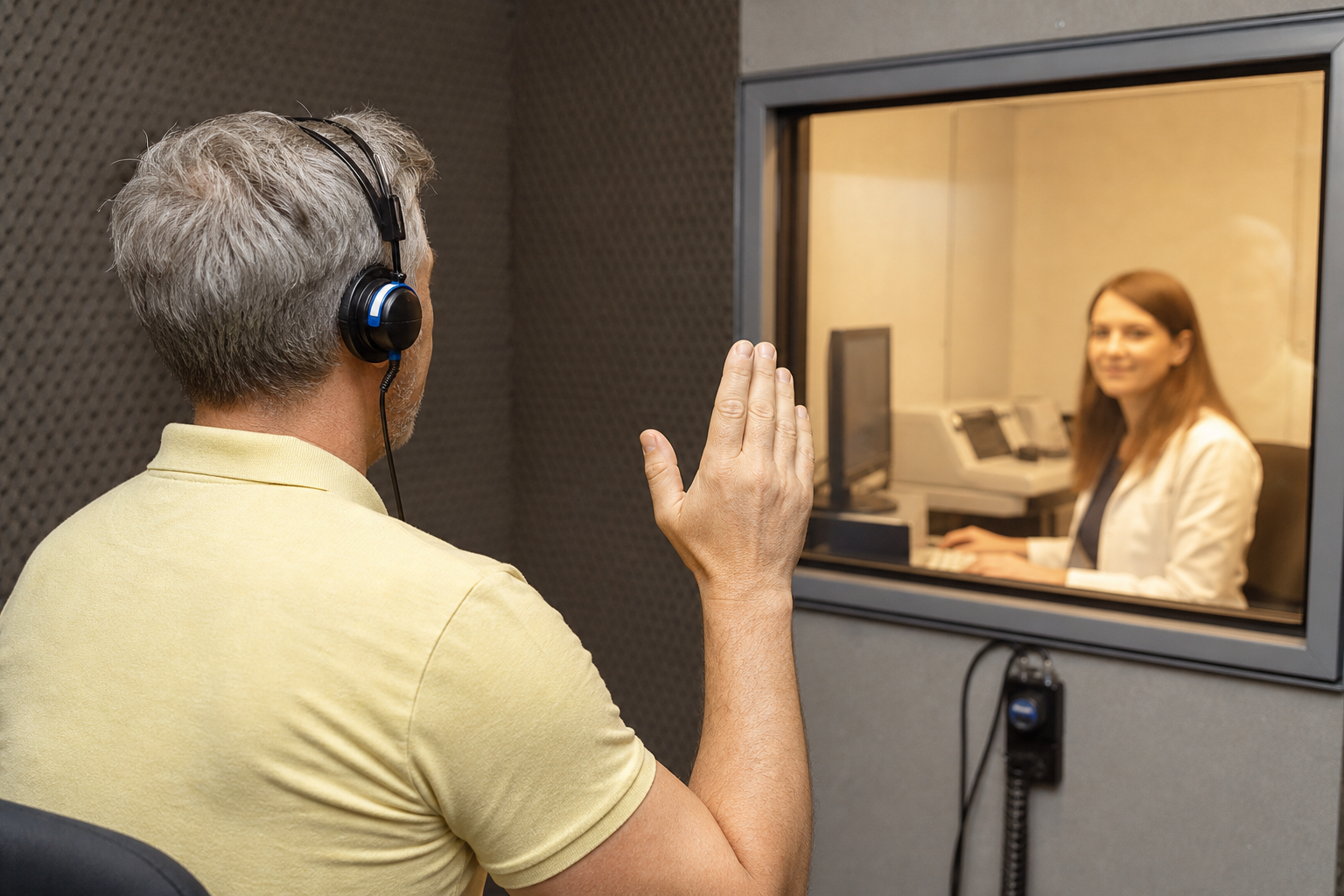
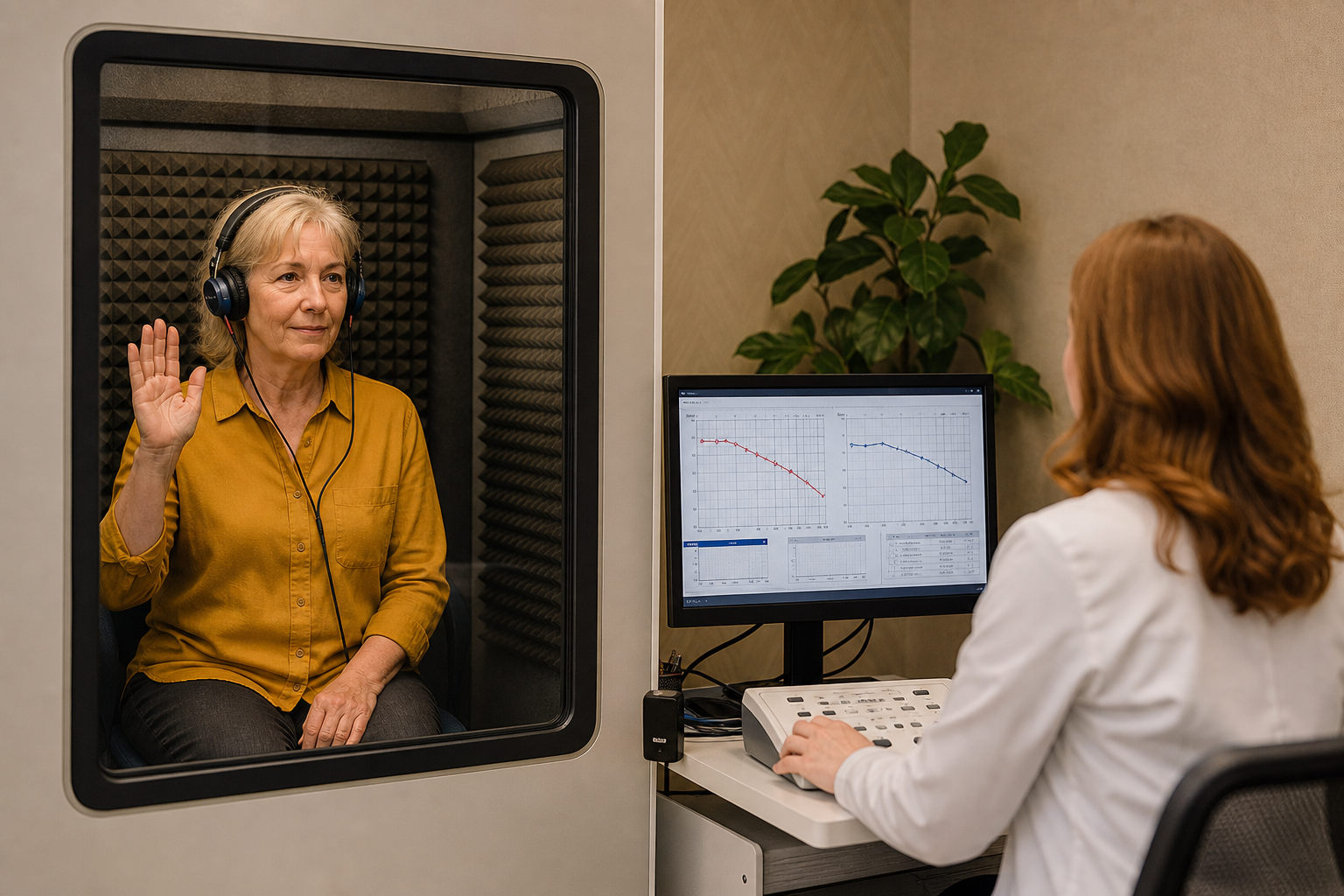
You move to the soundproof cabin. Tones of different frequencies are played through the headphones — from bass to high tones. The lowest sound you can hear at each frequency is recorded. Each ear is measured separately.
Sometimes bone conduction testing is added: a small vibrator is placed on the bone. This helps distinguish whether the loss is conductive (eardrum, middle ear) or neural. We explained the technical details in our article What is audiometry; You don't have to memorize it during the test.
4. Speech test (when necessary)
Pure tones do not fully reflect everyday speech. Sometimes words or sentences are played; It measures how much you understand. It is especially useful in device evaluation.
| Stage | Duration (approximately) | What you need to do |
|---|---|---|
| Preliminary meeting | 10–15 min | Explain your complaints |
| Ear check | 5 min | Sit down, relax |
| Audiometry | 15–20 min | Sign when you hear |
| Speaking test | 5–10 min | Repeat what you hear |
| Result description | 10–15 min | Ask your questions |
Do not think "what will happen if I make a mistake" during the test. Just give a signal when you hear it. Trying to guess in silence spoils the outcome — if you haven't heard, wait.
How to Read an Audiogram?
Audiogram is the map of the hearing test. There are frequencies (Hz) on the horizontal axis and sound intensity (dB) on the vertical axis. The lower the line or dots are, the louder sound you should hear at that frequency — meaning hearing is poorer in that area.
What does frequency mean?
The low frequencies on the left are bass sounds (male voice, engine hum). The high frequencies on the right are high-pitched sounds (child's voice, letters «s», «ş»). Most adult losses begin at higher frequencies first; Therefore, it becomes difficult to distinguish speech in a crowd.
Levels
General classification: 0–25 dB normal, 26–40 mild, 41–55 moderate, 56–70 moderate-severe, 71 and above severe loss. Looking at a single number is not enough; The entire profile is important. Your specialist will read this with you.
| dB range | Level | In daily life |
|---|---|---|
| 0–25 | Normal | No obvious problems |
| 26–40 | Light | Quiet conversation, noisy environment is difficult |
| 41–55 | Medium | TV, group chat affected |
| 56–70 | Intermediate-advanced | Device evaluation frequently recommended |
| 71+ | Next | Strong support required |
Don't say "I don't understand the graph" - your specialist will translate it as "you are weak at this frequency, that's why you are having difficulty with such and such". Feel free to ask questions.
Post-Test Roadmap
There can be three main ways when the result comes out. Which one is suitable for you will be discussed on that day.
Path 1: Tracking and protecting
In case of mild loss, a device is not necessary immediately. Avoiding noise, annual check-ups, and keeping headphone volume low may be recommended. Saying "Let's watch for now" is not negligence; It might be the right decision.
Path 2: Hearing aid evaluation
The device may be useful for moderate and above loss. The trial is planned; You look at how you feel at home and at work. SGK hearing aid support eases the financial burden — if the documents are complete.
Path 3: ENT referral
In cases of suspected conductive loss — such as earwax or middle ear fluid — medical treatment may be required first. If hearing improves after treatment, no device is required. If there is sudden unilateral loss, vertigo or discharge from the ear, it is necessary to see a doctor without delay.
You don't have to make a decision immediately after the test. Take the results home, talk to your family, come back in a week. Stay away from rush sales.
Audiometry with Hearing Test: Brief Discrimination
Clients sometimes ask "audiometry or hearing test?" Audiometry measurement itself; Listening to tone with headphones. The hearing test includes the entire appointment: speech, examination, and results interview. We explained in detail how to read the graph in our article What is audiometry. You don't have to distinguish between the two on test day; If you are wondering, you can ask "Is it audiometry now?" when the measurement starts.
Storing and Comparing Results
Save the audiogram in a file — paper or digital. When you get tested again three years later, the answer to the question "whether the loss has progressed" becomes clear only in this way. Hearing loss does not always progress at the same pace; An annual or biannual check may be recommended.
If you are a device user, periodic testing is a reference for programming. The complaint "My device feels weak" is sometimes a device malfunction or sometimes a change in hearing. The test separates.
What Should You Tell Your Family?
It is okay to come to the test alone. But when you take the results home, the "you didn't hear" conversation may start. For those who want to bring a relative to the appointment: that person will hear the results on the same day, ask questions, and you will plan the next step together. It would be good for your partner to come together, especially if he/she warns you that "you keep repeating things".
If your child has a test, it is recommended that both parents attend if possible. The child passes the test with play; You won't have to wait anxiously in the background.
A Few Notes for First-Time Visitors
Headphone pressure may be slight; If you say "it hurts" it will be adjusted. The cabin is closed but has air conditioning; Don't panic. There is game-based testing for children; Adult protocol does not apply.
Hearing test is not an "old age certificate". We see loss at both the age of 40 and the age of 30. Early measurement means early intervention.
Appointment in Izmir
We do hearing tests at Nokta İşitme Bozyaka and Yeşilyurt branches. You can fill out the form or call to make an appointment.
The test is painless, impromptu, and often provides same-day results. If you want a clear picture instead of uncertainty, just take one step. If you have questions, call before your appointment — we can also address your "will I show up for nothing" anxiety over the phone.
Frequently asked questions
Is a hearing test painful?
No. The tones you listen to through headphones do not cause any discomfort. You sit in a quiet room and signal when you hear. There are no needles, pressure or electric shock.
Is preparation required for a hearing test?
There is no special preparation. You do not need to come on an empty stomach or stop taking medication. If you have an ear infection or a severe cold, it would be better to postpone it.
How long does a hearing test take?
30–45 minutes for most people. The preliminary interview, measurement and result explanation end in the same appointment. It may take a little longer if additional testing is required.
Are the test results announced immediately?
Yes. The audiogram is drawn and shown to you in the same session. That day you will get the answer to the question "What do I hear and what do I not hear?"
Do I have to buy a device immediately after the hearing test?
No. The test is an evaluation. Depending on the results, follow-up, retesting or device recommendations are discussed. The decision is yours; There is no pressure.
Are hearing tests different in children?
Yes. Age-appropriate game audiometry or visual reinforcement methods are used. The process can be divided into short sessions.
Is the online test I take at home sufficient?
It may be useful for awareness; It is not sufficient for diagnosis and device decision. Testing performed with calibrated devices in a clinical setting is reliable.
Kaynakça ve Referanslar
Bu makaledeki tıbbi bilgilendirmeler aşağıdaki güvenilir kaynaklara dayanmaktadır.
- Audiometry — clinical overview — NCBI Bookshelf
- WHO — Deafness and hearing loss — World Health Organization
- T.R. Ministry of Health — Ministry of Health
 Hearing Tests
What Is Audiometry and How Are Results Interpreted?
What is audiometry and which tests does it include? Reading audiograms, mild-to-severe lo…
Read more → Hearing Tests
Are Online Hearing Tests Reliable?
Are online hearing tests reliable? Limitations of at-home screening, how professional aud…
Read more → Izmir Guides
Where to Get a Hearing Test in Izmir
Where can you get a hearing test in Izmir? Choosing a center, what to expect, audiometry,…
Read more →Contact us for a hearing test appointment