
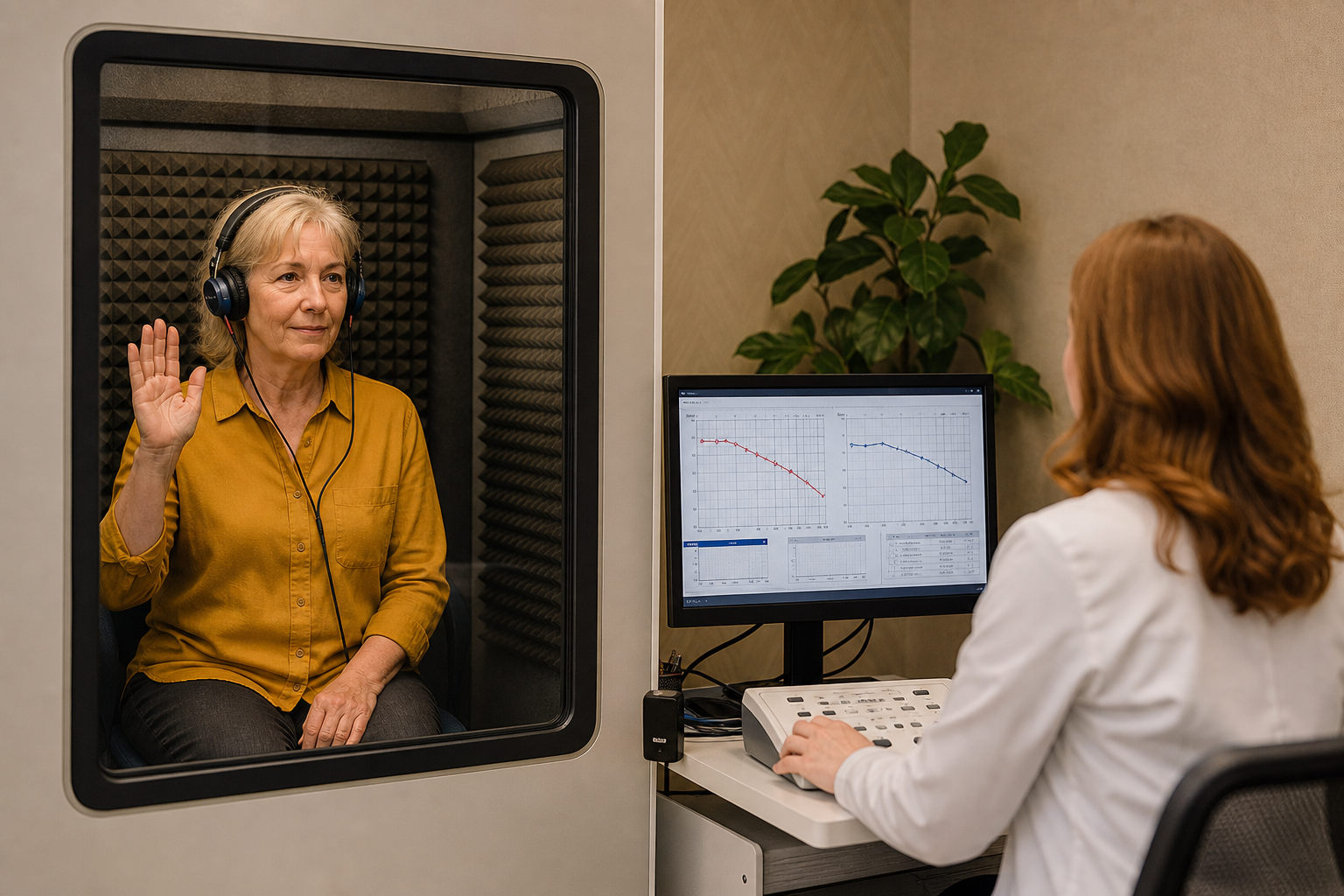
Medically reviewed by Nokta İşitme Audiology Team (Audiologist) according to hearing health information standards.
«What is audiometry?» Most clients who ask actually wonder: "Will they put something in my ear? What will happen if the result is bad?" Audiometry is listening to tones through headphones. You draw a chart and talk to your specialist. That's it.
A gentleman who came to our Yeşilyurt branch took the audiogram in his hand and asked, "What is the red line, what is the blue cross?" Ten minutes later he said, "So I was weak at 4000 Hz, that's why I couldn't hear my wife's voice." This is the job of audiometry: to turn the vague feeling of "I can't hear" into concrete data.
Audiometry Definition
Audiometry is the scientific method of measuring hearing thresholds. Pure tones of different frequencies are presented through headphones or a bone vibrator; The lowest intensity you can hear is recorded. These values are called hearing threshold
Hearing threshold: The lowest loudness (dB HL) at which you can hear a tone at a given frequency. The higher the threshold, the weaker you hear at that frequency.
Audiometry alone does not make a diagnosis. The history is interpreted along with ear examination and additional tests when necessary. But it is the gold standard in determining the level and type of hearing loss.
How to do a hearing test The technical heart of the process is audiometry. Measurement remains incomplete without a preliminary discussion and a concluding conversation; It cannot be called a "hearing test" without measurement.
Which Tests Are Covered?
«Audiometry» is not about pressing a single button. Subtypes are used according to the evaluation purpose.
| Test | What does it measure? | When? |
|---|---|---|
| Airway audiometry | Ear canal → conduction via inner ear | At each standard assessment |
| Bone conduction audiometry | Conduction to the inner ear via bone | To distinguish the type of loss |
| Speech audiometry | Speech threshold and comprehension | For daily communication performance |
| Pediatric / play audiometry | Thresholds in children | In age appropriate collaboration |
Airway audiometry
The most basic test. Headphones are plugged in; Tones from 250 Hz to 8000 Hz are played. Each ear is measured separately. This is the "hearing test" that most clients know.
Bone conduction audiometry
The small vibrator is placed on the mastoid bone. Sound travels to the inner ear through the bone. Air conduction and bone conduction thresholds are compared.
Conduction type loss: If the bone conduction is significantly better than the air conduction — the difference is usually over 10 dB — the problem may be in the eardrum or middle ear. Sometimes it gets better with treatment.
Sensorineural loss: If air and bone conduction thresholds are similarly elevated, the inner ear or auditory nerve may be affected. Hearing aids are generally considered.
Speech audiometry
Pure tones do not fully reflect the "ş" sound or whisper. The word list is played; How many words you repeat correctly is measured. It is critical in evaluating device benefit.
How to Read an Audiogram?
When audiometry is completed, the data is transferred to the audiogram. This is a map of your hearing profile.
Audiogram: Frequency (Hz) on the horizontal axis, sound intensity (dB HL) on the vertical axis. The right ear is usually marked with a red circle (○), the left ear with a blue cross (×).
Reading the axes
Low frequency on the left — bass sounds, male voice, motor. High frequency on the right — high-pitched sounds, «s», «ş», child's voice. The lower the symbol is, the louder sound you should hear at that frequency.
Typical old-age loss graph: relatively good at low frequencies, decreasing line at 4000–8000 Hz. That's why the feeling of "I hear but I don't understand" occurs - there is sound, but there is no clarity.
Asymmetry warning
If there is more than 15 dB difference between the two ears, it is called asymmetry. Sometimes additional ENT evaluation is required. Do not delay in sudden one-sided decline.
Mild, Moderate and Severe Loss Levels
Clinical classification is generally as follows. Don't get stuck on one average number; See the full profile.
| dB HL (average) | Level | What is felt? |
|---|---|---|
| 0–25 | Normal | No problem in daily communication |
| 26–40 | Light | Quiet conversation, noisy environment is difficult |
| 41–55 | Medium | TV, meeting, phone are difficult |
| 56–70 | Intermediate-advanced | Group chat has serious difficulty |
| 71–90 | Next | Even loud sound may not be enough |
| 91+ | Too far | Advanced amplification or alternative solutions |
Slight loss is not «insignificant»; But a device is not necessary for every slight loss. If daily life is significantly affected at a moderate level, device talk begins. In advanced loss, powerful devices or additional solutions come to the fore.
When to Consider Hearing Aids
The audiometry result alone does not say 'buy' or 'don't buy'. The following are evaluated together:
- Level and type of loss (conductive / sensorineural)
- Daily complaints — work, family, social life
- Speaking test score
- Age and general health
- Is there a chance of treatment in the transmission type?
Most clients with moderate to severe sensorineural loss benefit from the device. In case of a slight loss, saying "let's see again in a year" may also be a valid plan. In our Hearing aid selection guide, we explained the factors affecting the device decision.
In cases of conductive loss — such as earwax or middle ear fluid — treatment is tried first. Audiometry is repeated; If hearing improves, no device is required. That's why it is essential to read the measurement correctly before jumping into device sales.
Misconceptions
«Audiometry is only performed on elderly people»
No. We also see noisy work, concerts, ear trauma, and loss at a young age. There is no age limit.
«If a point on the chart is bad, you need a device immediately»
A single frequency deviation does not determine the entire decision. Profile, complaint and speaking test are read together.
«Bone conduction test is dangerous»
No. The small vibrator gives gentle vibration on the bone. It is painless and short.
«A phone application is sufficient at home»
Headphone quality, ambient noise and without calibration the result is unreliable. It could be for awareness; It is not enough for diagnosis.
«Audiometry cannot be performed while wearing a hearing aid»
Bare ear measurement gives the basic profile. Instrumented measurement can be performed to evaluate amplification benefit with a separate protocol. The two serve different purposes.
Masking and Measurement Reliability
When testing one ear, sound sometimes 'passes' to the other ear. This cross-hearing distorts the measurement. A low level of noise is introduced into the untested ear through a method called masking; so only the target ear responds.
Masking: A procedure applied technically by the clinician that increases measurement accuracy. You won't notice it during the test; It improves the result quality.
Soundproof cabin is also a must. If traffic or conversation sounds from outside come in, low-pitched tones are recorded as if they were missed — a "I could actually hear it, but the graphics came out bad" situation. There is no harm in asking about the cabin conditions of the centre.
Audiometry and Tympanometry
Audiometry measures hearing threshold. Tympanometry looks at the pressure in the eardrum and middle ear. In cases of suspected conduction loss, both can be applied together. Tympanometry is not a substitute for audiometry; completes.
A client who says "There is pressure in my ear, it feels like it is exploding" may first be asked for tympanometry and ENT evaluation. If middle ear fluid improves with treatment, audiometry is repeated; Hearing may return to normal.
Audiometry Results and Device Programming
If you have purchased a hearing aid, audiometry data is the basis of programming. How much gain will be given for each frequency is calculated from the audiogram. The device in factory settings does not fit your profile; That's why the first programming appointment is critical.
Profile change is monitored annually with audiometry. If the loss progresses, the device setting is updated. The complaint "It used to be good, now it's not enough" is sometimes not a device malfunction, but a change in hearing.
Before and After Audiometry
No special preparation. Postpone it for ear infections or severe colds. After the test, the result is announced in the same session; You may request a copy.
Save the results. Comparing the change in your profile over the years helps understand the pace of loss. It is a reference for periodic audiometry programming updates for device users.
Audiometry in Izmir
We perform standard audiometry in sound-insulated cabins at Nokta İşitme Bozyaka and Yeşilyurt branches. For an appointment, online form or phone call is sufficient
Audiometry is the digital language of your hearing health. Measuring instead of guessing — the first step to the right device, the right treatment, and the right expectation. You don't need to memorize the symbols on the chart; Your specialist reads it with you. Take notes and bring your questions.
Frequently asked questions
What is audiometry?
Audiometry is a standard hearing test that measures the lowest hearing threshold of the ears to pure tones of different frequencies. The results are transferred to the audiogram graph.
Are audiometry and hearing testing the same thing?
No. Audiometry is the measurement itself. Hearing test; It is the whole process that includes preliminary interview, examination, audiometry, speech test and result consultancy.
How to interpret audiometry results?
The location of the symbols on the audiogram indicates the hearing threshold. As you go down, it gets weaker at that frequency. The level (mild, intermediate, advanced) is determined by looking at the entire profile; One frequency is not enough.
Is audiometry painful?
No. Tones presented through headphones or a bone vibrator are listened to. No disturbing stimulation occurs.
Which audiometry result requires a device?
Decisions cannot be made with a single number. Device evaluation may be recommended if there is moderate or greater loss, a profile that affects daily communication, and low speech test scores. In cases of minor loss, initial follow-up may be sufficient.
How long does audiometry take?
Pure tone audiometry usually takes 15–25 minutes. If bone conduction and speech testing are added, the time will be extended. The full evaluation may take up to 30–45 minutes.
Can home voice testing replace audiometry?
It doesn't pass. Clinical audiometry is performed in a calibrated device and sound-insulated cabin. Home tests only provide awareness of «maybe I should get it checked».
Kaynakça ve Referanslar
Bu makaledeki tıbbi bilgilendirmeler aşağıdaki güvenilir kaynaklara dayanmaktadır.
- Audiometry — clinical overview — NCBI Bookshelf
- WHO — Deafness and hearing loss — World Health Organization
- T.R. Ministry of Health — Ministry of Health
 Hearing Tests
How Is a Hearing Test Performed?
How is a hearing test done? Preparation for first-time visitors, test steps, reading your…
Read more → Hearing Loss
What Are the Early Signs of Hearing Loss?
Recognizing the early signs of hearing loss matters. Read our guide to signals such as tu…
Read more →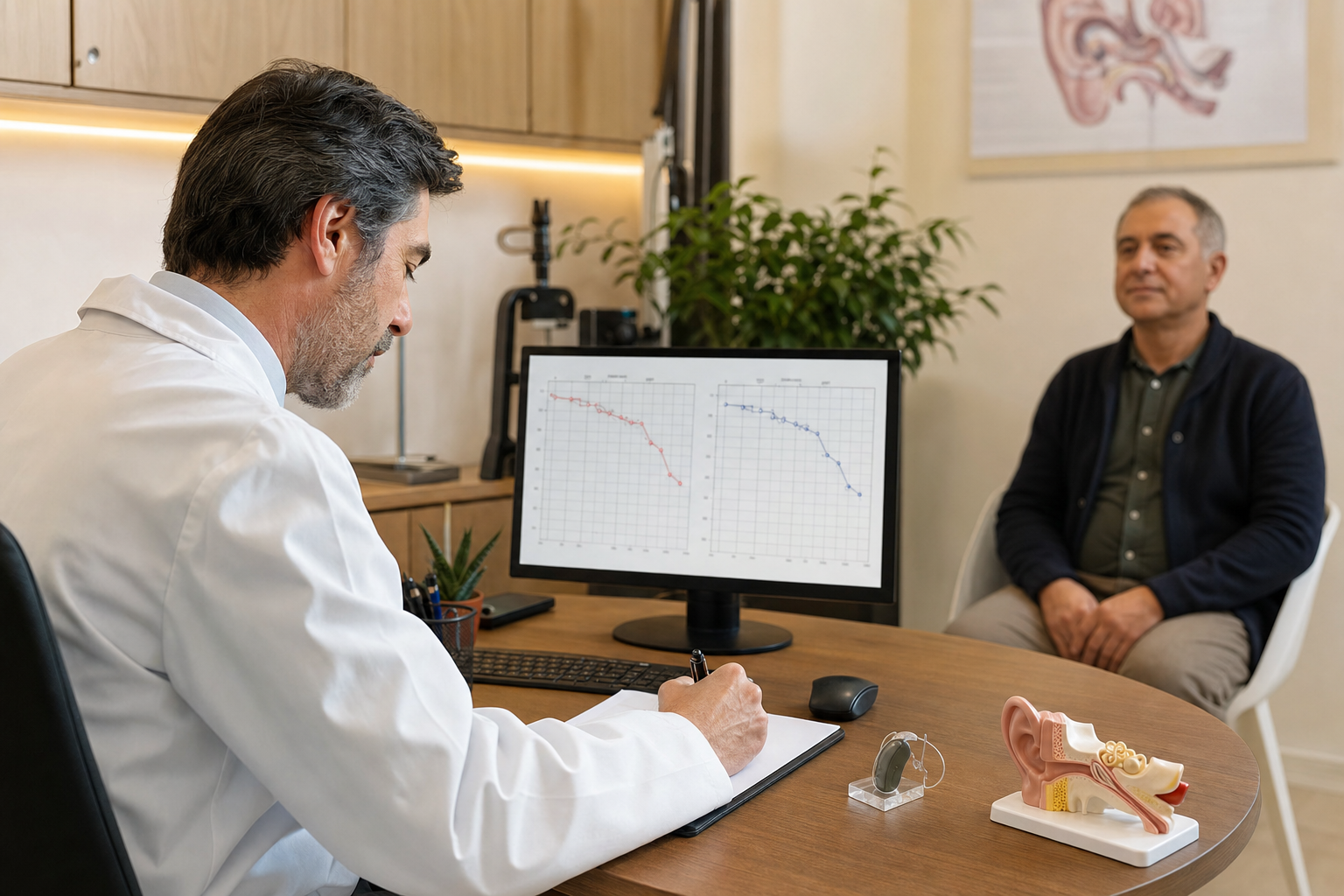 Social Security & Regulations
How to Obtain a Hearing Aid Report
How do you obtain a hearing aid report? Audiometry, ENT examination, report issuance, and…
Read more →Make an appointment for an audiometry evaluation