
Medically reviewed by Nokta İşitme Audiology Team (Audiologist) according to hearing health information standards.
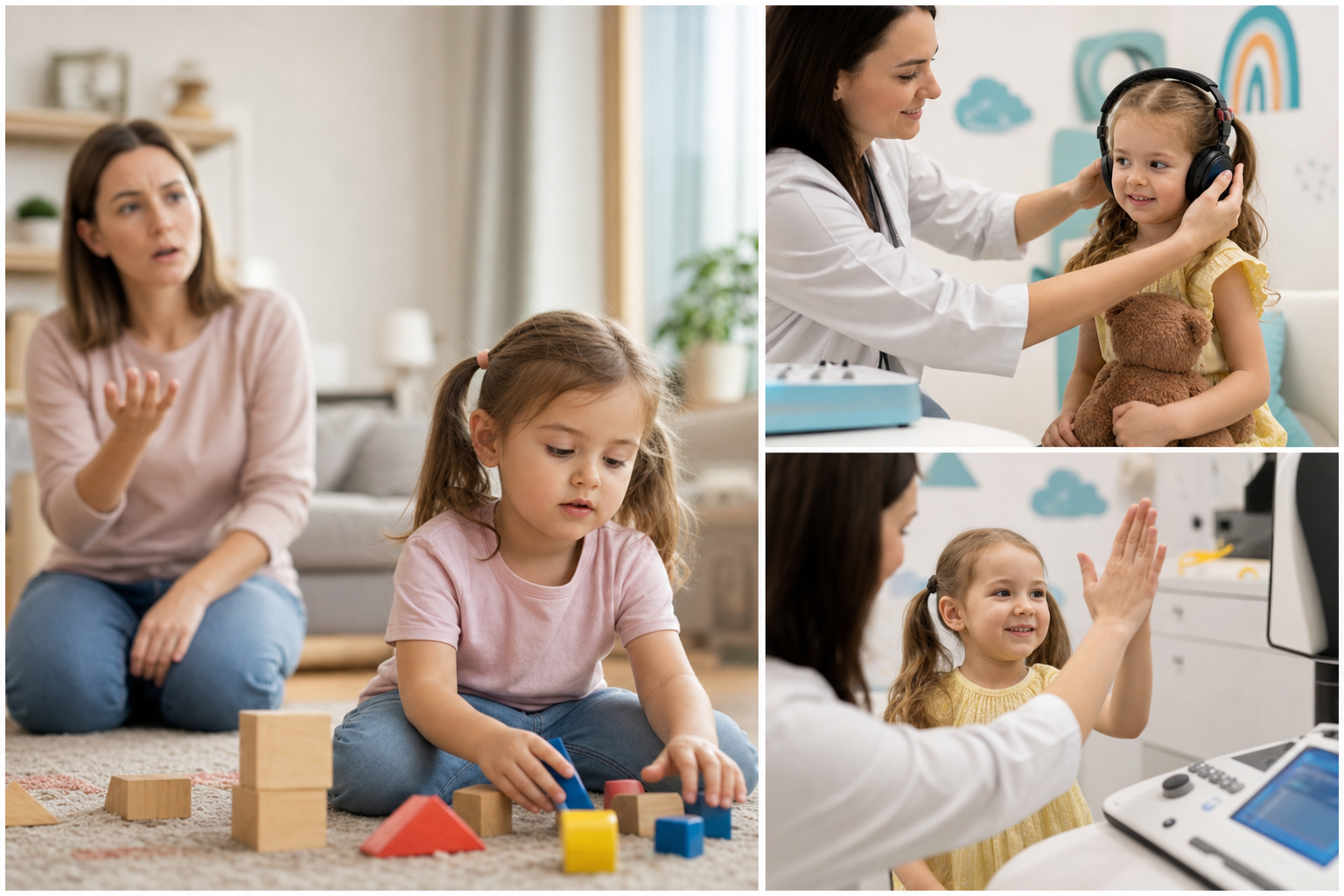
You feel uncomfortable when your child does not respond when you call his name or when his speech lags behind that of his peers. It's natural to immediately think of the worst-case scenario; But getting information before you panic will reassure both you and your child. When hearing loss in children is detected early, the chance of intervention is very high. In this guide, we explain the symptoms according to age and explain in simple language how the hearing test process works.
As a parent, your observation is very valuable. The doctor and audiologist gather small signs that you may not notice at home. Our aim is not to scare you; clarifying when you need to take action.
How Common is Hearing Loss in Children?
Congenital hearing loss occurs in 1-3 babies out of every 1000 births. In Türkiye, OAE testing is performed in the hospital within the scope of the newborn hearing screening program. This scan is very valuable; However, it is not always enough to say «once it turns out normal, ok». In later years, ear infections, fluid accumulation in the ear, or exposure to noise may lead to hearing loss.
Common causes in childhood are:
- Congenital hearing loss
- Recurrent middle ear infections (otitis)
- Fluid accumulation in the ear (serous otitis)
- Genetic factors
- Ototoxic effect of some drugs
- Head trauma
Symptoms by Age
Hearing loss in children looks different at each age. The following lists do not say «there is necessarily a loss»; These are signs that make you say "let's take a look".
0–12 months: Infancy
- Not starting or reacting to loud sounds after birth
- 6. croaking or significant delay in making sounds for up to six months
- Not turning your head when your name is spoken
- Lack of interest in sound toys
- Reference or retest recommendation in newborn screening
It is difficult to notice hearing loss because the baby does not speak yet. If the newborn screening shows a problem, a detailed evaluation is performed with the BERA test. This test is usually performed while the baby is sleeping.
1–3 years: Early childhood
- Starting to speak late or falling behind in word count of peers
- Explaining with signs instead of simple repetitive words
- The desire to watch television very loudly
- Frequent ear infections or suspicion of fluid in the ear
- Described as «drowsy» or «grumpy» — sometimes caused by hearing fatigue
This period is the year when language development is rapid. If hearing is inadequate, the child cannot fully perceive sounds; Syllables and first words such as «ba-ba», «da-da» may be delayed.
3–6 years: Preschool
- Pronunciation errors and difficult to understand speech
- Withdrawing in group games
- Frequent misunderstanding of instructions
- Image of the quiet child — he may not be participating because he can't actually hear
- Teacher feedback in nursery or kindergarten
6 years and above: School age
- Being distracted in class or labeled as a “wave”
- Misapplication of homework and instructions
- Don't say "what did you say" or "can you repeat that" often
- Decline in school success
- Difficulty in social relationships
Hearing loss in school-age children is often mistaken for a behavioral problem. The teacher saying "not paying attention" may actually mean not being able to hear from the front row. At this point, hearing test is a simple but effective clarification tool.
When Should You Get a Hearing Test?
There is no definitive 'immediate if this symptom' list; But it makes sense to schedule an appointment in the following cases:
- If you have been observing several of the above signs for more than a few weeks
- If newborn screening has been referenced in the past and follow-up has not been performed
- If you have frequent ear infections
- If a speech therapist or pediatrician recommends a hearing evaluation
- If there is a family history of hearing loss at an early age
Sometimes it helps to say "Let's wait a while, it will pass"; Sometimes yes in speech delay. But if hearing loss is suspected, waiting narrows the window of opportunity. The first three years are critical for language development.
How is Hearing Tested in Children?
The issue that parents are most curious about: "Will my child sit, cry, or hurt?" The hearing test suitable for children is painless and gamified according to age. We explained the adult process in our guide How to do a hearing test; The method is different for children.
Babies and toddlers
OAE (otoacoustic emission) measures the response from the inner ear; It can be applied while the baby is sleeping or very calm. The BERA test evaluates the conduction of the auditory nerve pathway. In play audiometry, when the child responds to sound, he sees a reward on a toy or screen; The feeling of «testing» decreases.
Preschool and school age
As cooperation increases, standard audiometry is used. The child wears headphones and gives a signal when he hears sounds. The environment is kept calm and warm; The parent may be in the room or just nearby most of the time. Duration is usually 30–60 minutes; Short breaks can be given depending on the child's attention span.
What you can do before the test
- Explain to the child simply, "They will check our ears, it won't hurt"
- Make sure he sleeps well and is not hungry
- Take his/her favorite toy with you (if it complies with the center rules)
- Try not to project your own anxiety onto the child — children read you
Post Testing: Results and Next Steps
After the test, the results are shared openly with the parent. If the hearing is normal, follow-up advice and practical information for ear health are given. If a loss is detected, the type and level are explained; ENT referral, device evaluation, or treatment of medical causes such as serous otitis are planned.
If hearing aids come up, the process can seem scary. However, today there are small devices suitable even for babies. Early device use supports language development. We have summarized the steps for the SGK process in our guide how to get a hearing aid report.
Conductive loss and fluid in the ear
Some of the conduction type losses that are common in children are related to fluid accumulation or infection in the ear. Hearing may improve after medical treatment; No permanent device required. Therefore, the test result alone does not mean that the device is required. Correct diagnosis is important.
Practical Notes for Home Observation
It is useful to keep observation notes for a few days before the doctor's appointment: in which environment he does not hear, to which sounds he reacts, whether one ear or both ears is in doubt. These notes help the expert during the test.
Tinnitus is rarely expressed in children; but they may say, "There is sound in my ears." If you have earache, discharge or balance problems, mention these as well.
Why is Early Intervention Important?
Hearing is the basis of language, learning and social bonds. Untreated hearing loss can affect school success, self-confidence, and friendships. Research shows that early intervention — ideally in the first months — produces the best results. When you become suspicious and get tested, you take the right step for your child.
Child Hearing Evaluation in Izmir
At Nokta İşitme, hearing test methods suitable for children are applied. In our Bozyaka and Yeşilyurt branches, the process is planned according to the age of the child; parents are involved in the process. You can ask your questions without hesitation.
Final Word: When in Doubt, Don't Procrastinate
If you are unsure whether your child has signs of child hearing loss, a hearing test can clarify the uncertainty. If the result is normal, you will be relieved; If there is a loss, you plan early. Trust your parental instinct — the feeling that “something is wrong” is often based on observation. Acting calmly, consciously and on time is the best gift for your child's development.
Frequently asked questions
How is hearing loss diagnosed in children?
It varies according to age: unresponsiveness to loud sounds in the baby, speech delay in the preschool period, distraction in the school age or frequent "what did you say" may be observed. A professional hearing test is required for a definitive diagnosis.
How is hearing tested in children?
The age-appropriate method is chosen: OAE and, if necessary, BERA in infants, play audiometry in young children, standard audiometry in school-age children. The test is painless and usually takes 30–60 minutes.
Newborn screening came back normal, is testing still required?
If there are no symptoms, routine follow-up may be sufficient. However, if there are frequent ear infections, speech delay, or behavioral changes, re-evaluation is recommended. Even if it is normal at birth, hearing loss may develop later.
Does hearing loss delay speech?
Yes. Children mostly learn to speak by hearing. If hearing is inadequate, sounds cannot be perceived correctly and speech development may be delayed. Early intervention helps reduce this delay.
Can a child be fitted with a hearing aid?
If necessary, yes, it is possible from infancy. Early device use is critical for language and social development. Device selection and programming requires pediatric experience.
The school says «careless», could it be hearing loss?
It could be. Some of the children who cannot hear the teacher in the classroom or misunderstand instructions have underlying hearing loss. Hearing testing is an important step in evaluating school problems.
How to get a hearing aid report for children?
First, a comprehensive hearing test is performed. According to the results, the ENT physician or the authorized center issues a hearing aid report. A report and certain documents are required for SGK application. See our hearing aid report guide for detailed information on the process.
Kaynakça ve Referanslar
Bu makaledeki tıbbi bilgilendirmeler aşağıdaki güvenilir kaynaklara dayanmaktadır.
- WHO — Child hearing loss and ear care — World Health Organization
- T.R. Ministry of Health — Newborn screening programs — Ministry of Health
- Pediatric hearing screening — overview — NCBI Bookshelf
 Hearing Tests
How Is a Hearing Test Performed?
How is a hearing test done? Preparation for first-time visitors, test steps, reading your…
Read more → Hearing Loss
What Are the Early Signs of Hearing Loss?
Recognizing the early signs of hearing loss matters. Read our guide to signals such as tu…
Read more → Hearing Tests
What Is Audiometry and How Are Results Interpreted?
What is audiometry and which tests does it include? Reading audiograms, mild-to-severe lo…
Read more →Get a free hearing evaluation for your child